Sunday, 9 June 2013

Jejo-do for our third and last Spring Tour

On our way to Jeju-Island
 

The Spring Tour is since the 60’s a yearly returning teambuilding event, hosted by the Korean General holding the position as the Senior Member in UNMAC (United Nations Armistice Command). Every other year the destination is Jeju-do, which is the biggest island of South Korea and located in the south-west of the Korean Peninsula. More than 90% of this volcanic island is covered with basalt rocks.
With a group of 38 people we travelled by military plane to the island and had a well organised program filled with office calls, learning more about Korean history and culture. The weather was fabulous and the sites spectacular. The team building in my opinion was not the best I’ve experienced but not every leader is gifted with social competence and a sincere interest in other people. However, I hope it gave the participants an insight of what can and should be done differently.


After visiting Jeju Defense Command and Jeju Provincial Government we went for lunch. Anders here with Millan and Douglas McDonald from Canada.


Visiting Samsunghyeol, were we as the legend tells could see the trace of Jeju's birth. Three gods soared from the earth and three holes were shown as proof.


Greeting the national symbol of Jeju-do
 
 
A strole on 1100 meters Altitude Wetland, which is a typical mountainous wetland.


On our way to the first evening’s joint dinner consisting of Black Pork Korean style barbeque which was followed by Karaoke.


Day two we went:
Tracking at Oedolgae Rock


and took the ferrie to the Island of Mara which is the most southern btip of South Korea.


Here we met a Buddist Monk and his assistant who both spoke great english and we learned that you can stay over here: call (+82) 010-7488-5321 and talk to Miss Ahn.

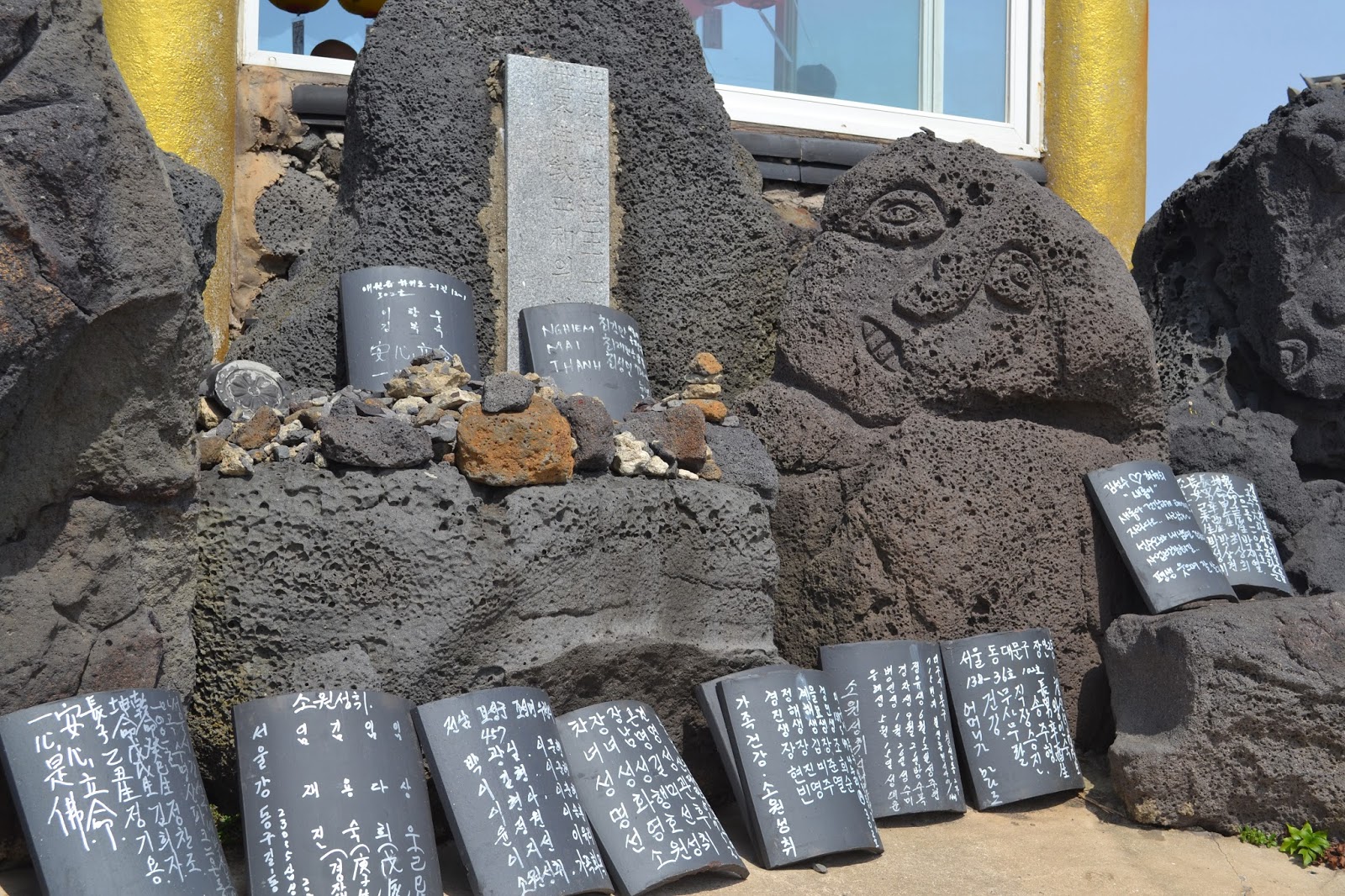


Many visitors write their message on a roof tile and have it exhibit for a long time donating a small sum for support, so did we :)

 
Final Day, climbing Seongsan Sun Rise Peak so we could enjoy the breathtaking scenic views of this 99 rocky peaks surrounding the crater like a fortress! For us not possible due to the fog but we did climb with many other visitors!


Final lunch and a walk in a Folk Village that has preserved and recreated a traditional Jeju town as it used to be before returning to Seoul.


Sunday, 2 June 2013

My first visit in a Korean family home, thank you Nam Hwa!


A gloomy, raining, humid and hot day during this last week in May, I was invited and picked up by my friends Nam Hwa Kim and Sangeun Seonwoo.  I had teased Nam Hwa for over a year, telling her that I enjoy her friendship and like having her coming over to me on base. However, I would definitely appreciate if I also could see her home. Finally, D-Day had come!

I surely felt welcome when I entered her nice apartment and saw the welcome letters pinned up on the wall. Nam Hwa’s daughter had made it and I hope her mother told her how much I liked it.
I believe the family had a large apartment for living in central Seoul. And the rooms I saw were nicely decorated and for the world I couldn’t understand why she didn’t want me to see it.
 
A small part of Nam Hwas' husband's coin collection.


We chatted a lot while drinking champagne and eating fresh fruits.


Later than planned we went out for lunch at a wonderful restaurant where we had the Korean dish, with lots of fresh vegetables’ and very thin sliced beef which we broiled in bouillon. Delicious!


It's a serious matter to pick the ingrediences you want to cook! But the result was fabulous..................


We ate and ate and enjoyed our time together until the restaurant closed in order to prepare for the evening guests!


Than after a miraculous maneuvering of Nam Hwa to get the car from the parking spot, we went to e:Mart for some shopping.
 
All together a great day with my wonderful friends Nam Hwa and Sangeun.


My friends trying out samples, which is always a part of shopping in Seoul!

Sunday, 26 May 2013

I never learned Hangul……


Being a linguist, I immediately, when I moved here in March 2011, started up to learn the native Korean language, Hangul. However, not very long into my studies I noticed that the Koreans are perfectionists and have their specific area pronunciations of the same words. This resulted into the fact that I was constantly corrected, which made it not very much fun to continue, so I stopped.

Coming from minor language areas I’ve studied and use several international languages. But none of them helped me here in Korea. Instead I became an expert on body language, but this made me very much aware of the fact that the overall competence in the English language is at a very, very low level, with of cause some exceptions.


After more than two years in South Korea this has become an area of irritation for me. Even in the Korean military, English is bad and this surprises me since the Korean military has worked with the Americans for over 60 years. One can’t learn all the different languages, but one can at least learn and speak one major foreign language.

It’s nice to be proud of your country; it’s also nice wanting to be good at what you do, but this being proud and perfect isolates the people of this country. Fifty million South Koreans, twenty million North Koreans and about ten million South Chinese people speak Hangul which makes it for me: a minority language.

What Doktoro Esperanto*) wanted hasn’t been achieved. However, English is today the most used second language bringing people together and enabling us to learn from each other. So I sincerely hope that the Hangul speaking people throw their perfectionism aside and interact with the international communities and widen their horizon.  


Ludwig Zamenhof 1887    


*) Doktoro Esperanto means a doctor with hope and was the pseudonym of the Polish Doctor Zamenhof, who in 1887 published his international language. Esperanto was meant to be a second language for all people. His hope was that this would lead to increased understanding and lesser risk for war and conflicts between different countries.  


The Korean alphabet, also known as Hangul or Chosongul is the native alphabet of the Korean language. It was created during the Joseon Dynasty in, and is now the official script of both North Korea and South Korea, and co-official in the Yanbian Korean Autonomous Prefecture of China’s Jilin Province.

Hangul is a true alphabet of 24 consonant and vowel letters.


But it surely looks beautiful!!!

Sunday, 19 May 2013

Public facilities in Seoul

In the main shopping street at Itaewon..........


People wondered what I was doing,
when I took pictures of the toilets :)


Having worked for a decade with bathroom products from Ifö Sanitär, I can’t deny that I still have a great passion for these products. This has as a result that I always look at those products everywhere I go. During my years here in South Korea I can´t say anything else than that I´ve been very impressed by the way the city of Seoul foresees the people with clean, well functioning, free of charge and good availability of public toilets. Although I definitely have a preference for the Nordic design of toilets I think many countries, including Sweden, should learn from Korea in the way the country handles the public facilities. No matter where you go: subway stations, shopping malls or shopping streets you´ll always have access to impeccable facilities.


As curiosa: while I went to take some "toilet-pictures" in the subway station of Dongjak, Anders waited for me at this subway station's "children library"! Have you ever seen that anywhere? I haven't!

Friday, 10 May 2013

Manila here we come!


A long time it had been my wish to visit the Philippines and became through. Together with my friend Chi, I went off for a six day trip! Especially Chi deserved a vacation and to be away from what is called "The Peninsula" (but in reality an island for we can’t just take the car and drive to China or?) after living here for two years.

Filled with expectations and very happy to have found a first class hotel (five stars!!!) for half the price, we checked in. Problems! No reservation found and we needed to contact our travel agency to get a refund. No room either. After several times hearing their excuses, I mentioned that I as a journalist would use all my contacts to write about the Pan Pacific. Things happened! We were upgraded, got fabulous breakfasts and were pampered from morning to evening! (But I surely can recommend the place, great location, fabulous hotel, fantastic service and good food!)
What will happen now?             


               We'll go for a swim!

We decided to have a "half-half" vacation: exploring and sunbathing.
So we did and went to see the Old Town, called Intramuros with horse and carriage. 

 This being the oldest district and historic core of Manila was absolutely wonderful. The name comes from Latin and means “within the walls” which were built in the late 16th century by the Spaniards to protect the city from foreign invasion. We visited the Rizal Park and museum. José Rizal lived from 1861 to 1896 and was a Filipina nationalist and reformist. He’s considered as one of the national heroes of the Philippines. Rizal was a polymath; besides medicine, he was also an artist who painted, sketched, sculpted and did woodcarving. He was a prolific poet, essayist and novelist. In short a man with many talents!


 Following in Rizal footsteps?
We also visited the National Art Museum, had a drink on the boulevard after we strolled on it, rode the Manila Eye, shopped at The Mall of Asia and the last day we took a day tour to see the Taal Volcano.


On our day tour we stopped at the Jeepney factory, producer of the most popular means of public transportation in the country. Afterwards we paid a visit to The Las Piñas Bamboo Organ, being the world’s oldest organ made of bamboo, in the St. Joseph Parish Church. And the organist played several songs for us! From our tourguide we learned about but also saw the poverty in the country.

 
    The Beautiful old Catholic Church with..... 
 

    The unbelieveble sounds coming
    from the bamboo organ!
 
 
    The tasty fruits everywhere along the road side,
 
 the colorful plant stalls, and.....              
 
    the fun cultural dances performed at Barbados in Intramuros.


When we arrived at our destination we were breath taken by the sight of the Taal Volcano. This volcano is the second most active volcano in the country, with its 33 historical eruptions and is located on the island of Luzon. We viewed the Taal Volcano and Lake from Tagaytay Ridge and were presented a most picturesque and attractive view.


The relaxing at the pool gave us a good shot of D-vitamins and some color. Too soon time to return to Seoul… Although also nice to be with Anders again!